Secure Multi-Party Computation
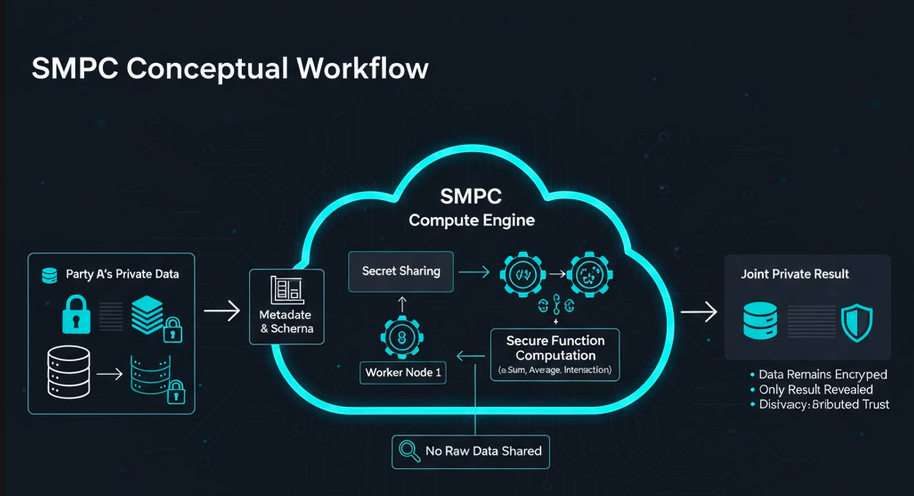
Secure Multi-Party Computation (SMPC) enables multiple parties to jointly compute a result based on their private data without any party ever seeing the others' raw inputs. By distributing the "trust," data is broken into meaningless fragments (secret shares) and processed across independent nodes.
Our approach facilitates complex analytical workflows and machine learning training where no single entity is allowed to see the consolidated dataset, ensuring compliance with the highest global privacy standards.
Cryptographic Foundations
Secret Sharing Schemes
Utilizing Shamir’s Secret Sharing or Additive Sharing to split data into "shares" distributed among multiple nodes, ensuring zero information leakage.
Garbled Circuits
Implementing optimized Yao's Garbled Circuits for secure boolean evaluations, allowing for private comparisons and logical decision-making.
Oblivious Transfer (OT)
Facilitating information exchange where the sender is oblivious to what the receiver chooses, and the receiver learns nothing else.
Homomorphic Pre-computation
Leveraging semi-homomorphic techniques to generate "Beaver Triples," accelerating the online phase of multi-party multiplications.
Threshold Cryptography
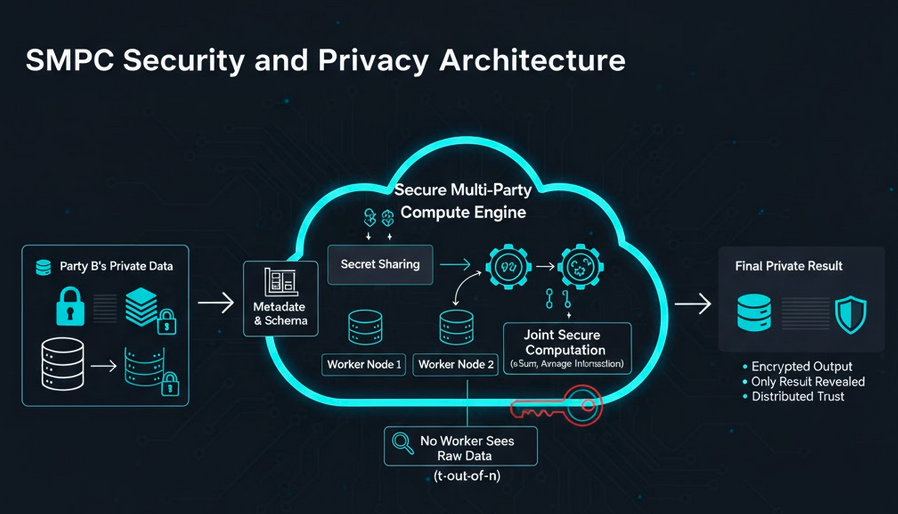
Ensuring that a minimum number of parties must collaborate to perform any sensitive operation, preventing single points of compromise.
Malicious-Secure Protocols
Advanced zero-knowledge proofs and consistency checks to ensure computation remains correct even if some parties behave dishonestly.
Privacy & Security Architecture
Distributed Trust Model
Unlike centralized cloud computing, SMPC eliminates the need for a "Trusted Third Party." Data security is guaranteed by mathematics; an attacker would need to compromise all nodes simultaneously.
Private Set Intersection (PSI)
Our framework supports specialized PSI protocols, allowing entities to find common elements in their datasets without revealing any extra information.
High-Value Use Cases
Financial Crime Detection
Allow banks to collaborate on anti-money laundering signals across different institutions without exposing sensitive client histories.
Healthcare Data Linkage
Join clinical records with genomic data to find life-saving correlations while maintaining total patient anonymity.
Supply Chain Optimization
Enable competitors to calculate industry-wide metrics like average lead times without revealing proprietary vendor lists.